Tuesday, November 9, 2010

Part Two of book


Part two of the book focuses mostly on exposures, lighting, depth of field, designing your picture space as far as dominance and such.  The first part on exposure brings up important information on a feature built into most new digital cameras.  The histogram is used to determine points of accuracy of your exposure for a shot.  Exposure is controlled by aperture size and shutter speed, which can be set to adjust automatically or be adjusted manually.  It is important to know how to adjust exposure settings such as aperture priority, shutter speed, and knowing the different metering patterns used as well in order to adjust for different lighting situations and such. 
                Cameras stick to a neutral 18% grey basis; therefore, you must work against the cameras basic grey adjustments in order to correct it for a more quality picture.  The best tip that the book presents about lighting is one that every photographer should know, and that is, try and avoid if at all possible shooting in the bright midday sun.  This will only cause your shots to be overly bright, and your detail will be lost to the excessive contrast built up from the overly bright light.  The best times to go out and shoot are sunrise and sunset, because the light gives you either front light which is good if you want to portray saturated color, contrast between different colors and fine detail in all parts of the scene; sidelight which produces long, deep shadows that reveal wrinkles, dimples, ridges and other details of a surface in greatest relief; and backlight is great if you want to dramatize on subjects with indistinct, shaggy, peripheries and features.  Depth of field comes up and is basically being able to focus on one main part of a subject and defining one specific feature of it, while still revealing a quality portrait of the rest of the subject as well. 
                This is also used in landscapes where either there is one single or a couple of focuses going down the line of one large landscape portrait.  Motion effects are mentioned as well where you can either catch a subject such as a hummingbird in mid-motion noticing that there is movement in its wings, while the rest of the bird seems to be still, as well as taking a shot of a stream and having the flow motion blurred from a slowed shutter speed shot.  One of the most important sections in this part of the book fall into the dominance section and is a good idea for any photographer to have knowledge of.  These are:  Red is more attractive than yellow; Large draws more attention than small; difference draws more attention than conformity; jagged lines are more striking than curved ones; diagnol lines are more attractive than vertical ones; sharpness is more attractive than blur; and light is more important than dark.  Another basic knowledge of photography mentioned is also the rule of thirds, which sometimes does need to be broken but only in necessary terms. 

Sunday, November 7, 2010

11/04/2010 book blog post pgs1-50

I guess to begin this entry I will start with the section of Intrigue with Tiny Creatures.  When I take photos, I more than often catch myself taking pictures of things such as leaves, plants, bugs and such close up and otherwise known as micro shots.  According to the book, you cannot make frame filling records of subjects with plain standard lenses.  It says that you must buy special close-up adapters that are either specially designed for the type of shooting, or macro lenses.  Accessories that they mention include items such as screw on supplementary filters which work just like magnifying glasses.
 This is useful to me for future use if I ever intend on really focusing more on macro shots and wanting them to come out with extra quality and they recommend two-element supplementary lenses for the purpose of quality.  Another accessory that the book mentions and are somewhat inexpensive and are available in many stackable sizes are hollow tubes called extension tubes.  The next section in the first fifty pages that I find useful is the chapter on super-telephoto lenses.  Under the focal lenses section it begins by providing the basics that if you have a full-frame sensor, anything less than 500mm is too short and anything longer than a 600mm is too long.  A 500mm lens is more ideal than a 600mm as well because it is only about four or five pounds lighter and allows for more mobility, therefore, less fatigue occurs to the photographer. 
There is the argument that a 600mm lens does come in handy for those far shots on a very tiny subject, but more often than not, photographers will find themselves with over magnified images.  The 500mm lens would be the most ideal for me if I was a professional photographer, being that I am the type that likes to go off trails and through rugged terrains.  They mention ways that you can save on these lenses, or actually cheat build them in a way.  To do this, you can combine either a 300mm or 400mm lens with 1.4X and 2X tele converters, but quality of an image will be compromised at comparable magnifications. 

Thursday, October 28, 2010

Angle, Distance, and Yes!

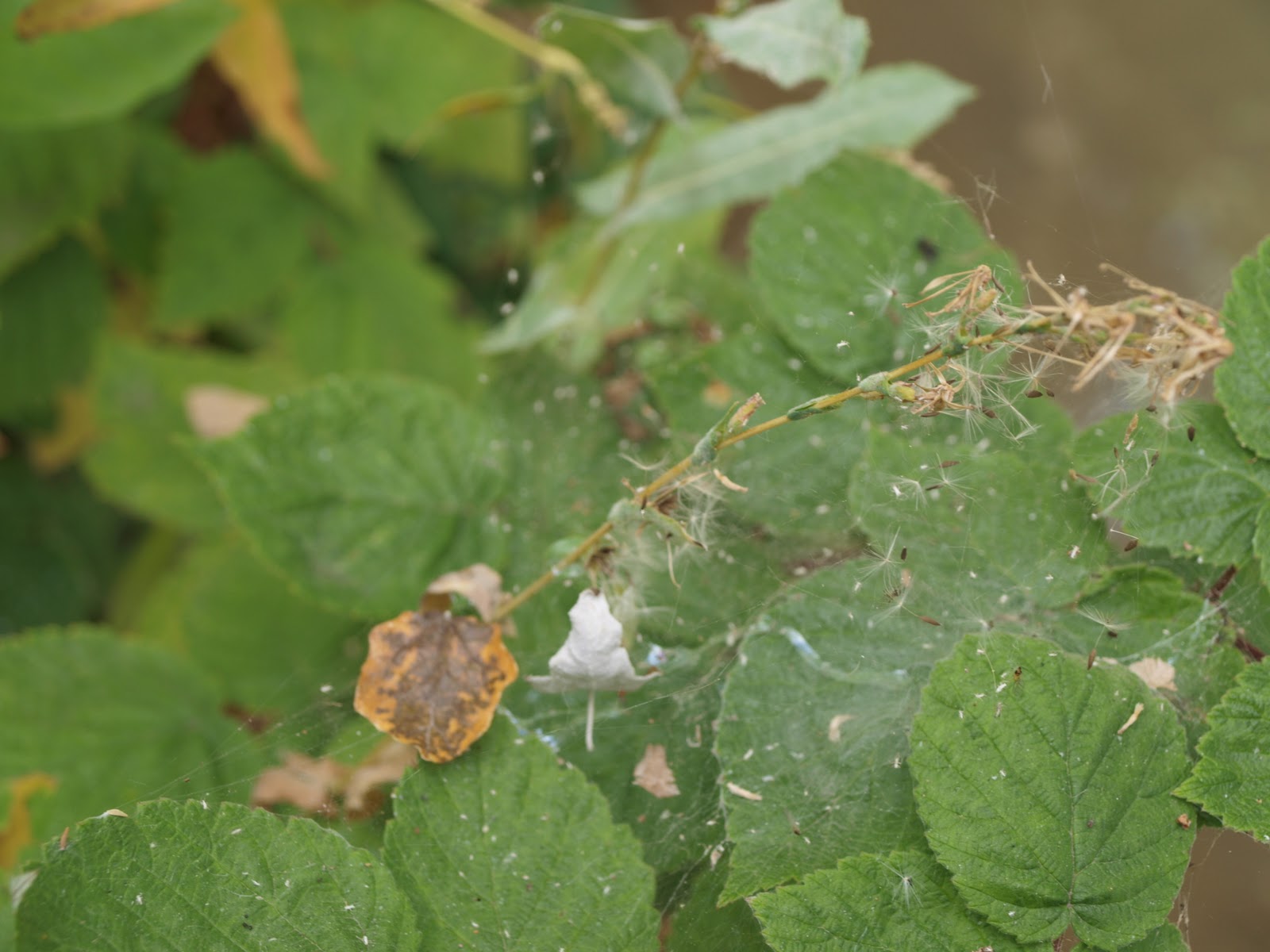
                It is amazing of the many different angles that you can present basically the same picture.  In these shots I was just randomly shooting out back of our house along a canal that crosses just on the other side of our fence.  As I was shooting leaves and other things falling in and floating down it, I looked down and saw this plant with some sort of webbing on it.  I thought it would be quite the neat picture.  I looked at my first shot and realized that it really wasn’t all as great as I had figured it would be.  After taking more pictures and getting ready to leave, I looked back down at the plant and was trying to think of a way to make the shot work.
                I started repeatedly taking pictures of the plant with the webbing on it, and then got the idea of getting closer.  Well, that helped a little bit but not of how I was wanting the picture to come out.  Just before getting extremely frustrated with the pictures produced from my shots, I thought, “why don’t I just mess with the angles”.  “Of course”!  With the combination of trying different angles and moving closer, I was able to come to a shot that I liked.  The last one I have posted is like being eye level with the plant, and turned out to be my best shot of it.  The quality of the shot was great and has good detail on the webbing and other things attached to the leaves. 

Thursday, October 21, 2010

Two articles ASSIGNED!

The Land of the Oz
Stepping carefully into Australia

                The author of this article, Bill Hatcher, writes about his adventure into living in the new land to him from the Colorado Plateau to, Australia.  The place he resides to is just on the outskirts of Sydney, Australia which resembles much of America’s southwest desert.  The great thing for him, however, is that he does not live far from what is called the Australian Bush. The “bush” contains a massive variety of animals including some of the worlds’ most venomous snakes and spiders, which I might add that the spider thing would not be to my favor in any way shape or form.  He asks a very important question to himself for living, and also as a photographer as well.
                Since the author plans to be living in Australia for a few years, “as a photographer who often goes off the beaten path to shoot photos,” he asks, “ is just how dangerous is the Australian countryside.  For his own knowledge, he does much needed background research on the wildlife both where he lives and in the Australian bush.  Something that I found interesting that he had noted is that 11 of the world’s 15 most venomous snakes reside there in Australia, and that is including the sea snake, tai pan, and king brown snake.  It is also full of many other types of wildlife such as tropical birds, much of what you would find in a jungle because the Australian bush is basically a jungle. 
                Bill’s main worry as a photographer, however, will rely on him being careful with his steps and observing not only surroundings, but the ground around as well.  Most people whom get bitten by venomous snakes in the bush are generally bitten in the ankle, which can mean only one thing.  For the most part people step on the snake or in its space causing it distress and then it bites.  He explains that most of the snakes in the bush are not aggressive and just reclusive and the disruptions disturb their peace.  The reason a snake could be considered most deadly is because they tend to have more human encounters, Bill explains. 


The Masters of the European Landscapes
England

                The author, William Sawalich, begins the article with the fact that American photographers began the foundations for modern mainstream landscape photography.  In comparison to American landscapes, the author believes that European photographers emphasize intimate landscapes more so than vista.  European photographers as well are concerned more with the form or abstraction and simplicity that are less location sensitive.  In exploration of abstraction he says that the perspectives are less dramatic and the lighting is more quietly portrayed.  Sawalich makes a good point about photography in his eyes, and kind of falls true to photography as I see it as well. 
                What fascinates him about photography is , “How an art form, on one level, the most perfectly descriptive, yet invented by man can transcend the overwhelming weight of bald description to evoke something unexpected. “  I think it’s neat to think about the world in a photographic kind of way, which is how I believe the author means it.  To see many or all of the things you look at and view, and turn it into the vision of a picture.  There are so many plain and simple sights that we see every day, and if we were able to convert that into a picture itself, it would portray much more than what was seen at the time.  This all leads into what the photographer/author says to be his favorite place to photograph.
                “My favourite place to photograph is the one with which I’m emotionally engaged at the time I’m making that image; all other locations pale at that moment.  I feel like the author is very right about his statement.  A picture is only at its best when the photographer him or herself is really feeling the shot and has full confidence that “this is the one”.  Sure, there are many times that you can go out randomly shooting and get a really nice photo, but the true great picture would be that one that you want and emotionally feel enlightened when the shot is achieved.

Tuesday, October 19, 2010

Iso/shutter/aperture

This night it was around seven to seven thirty, and i decided to try and get some shots of the sunset at Zimmerman Park.  Unfortunately, I left a little too late to get the sunset itself and instead took shots of the sun almost down.  My gaol now was to get the color of the background with the sillouettes of the trees because i felt like that would be a neat idea.  Since it was pretty much dark now, I had to mess with some of the settings on my camera.  I set the ISO to about 400 I believe, which was giving me the best quality shots as far as seeing the whole background color with the sillouettes.  I got a few decent shots with it, but then they were coming out too dark.  In combination with my aperture/exposure going up, my shutter speed would go down.  This gave me a much brighter picture, but then I had a blurred effect because i was not able to hold the camera still without a tripod.  Then i figured out how to speed up my shutter speed and leave the exposure and aperture close to the same.  The result was my second picture down, which came out fairly decently.  My favorite shot of these, however, is the very top one.

5 Favorites